

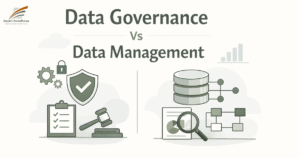
In today’s digital economy, businesses run on data. However, simply collecting data is not enough. Without proper structure and oversight, valuable data can quickly become messy, inconsistent, and unreliable.
This is where Data Governance and Data Management come in.
Many organizations use these terms interchangeably. While they are closely related and work together, they are not the same. Each plays a distinct role in a company’s data strategy.
Understanding the difference helps businesses organize their data better, improve decision-making, and avoid costly operational mistakes.
Let’s break down what each one means and how they work together.
What is Data Governance?
Data Governance refers to the policies, rules, standards, and responsibilities that guide how data is used, protected, and controlled within an organization.
In simple terms, data governance answers the question:
“Who is responsible for our data, and how should it be used?”
Think of data governance as the rulebook for data, ensuring that information across the company is reliable, secure, and used responsibly.
Data governance typically defines:
- Who owns specific datasets
- Who has permission to access certain information
- How data should be classified and labeled
- How privacy and compliance requirements are enforced
- Standards for data quality and accuracy
For example, in a company that handles customer information, data governance policies may include rules such as:
- Only finance staff can access payment information
- Marketing teams can only use anonymized customer data
- Customer records must follow a standardized format
- Sensitive data must be encrypted
Without these rules, employees may access data they shouldn’t see, duplicate records may appear, and critical information may become unreliable or exposed.
ALSO READ: The Future of Business is Data-Driven
What is Data Management?
Data Management focuses on the practical execution of handling data. It involves the processes, technologies, and systems used to collect, store, organize, maintain, and secure data throughout its lifecycle.
If governance defines the rules, data management ensures the game runs smoothly.
It answers the question:
“How do we actually handle and maintain our data every day?”
Data management activities typically include:
- Collecting data from multiple sources
- Storing data in databases or data warehouses
- Cleaning and organizing datasets
- Integrating data from different systems
- Backing up and securing information
- Preparing data for analytics and reporting
While governance focuses on policies, data management is where the operational work happens.
For example, a data management team might:
- Build a centralized data warehouse
- Implement tools to remove duplicate customer records
- Ensure databases are backed up regularly
- Monitor system performance
- Structure datasets for dashboards and reports
These tasks ensure that employees can find, access, and use data efficiently.
Without effective data management, even the best governance policies will fail because the systems needed to enforce those policies will not exist.
How Data Governance and Data Management Work Together
Rather than competing concepts, data governance and data management are two sides of the same coin.
- Data Governance provides the framework
- Data Management provides the execution
Example 1
Data Governance Rule:
Customer data must be accurate and standardized.
Data Management Action:
Data engineers implement automated tools that clean and standardize customer records.
Example 2
Data Governance Rule:
Only authorized employees can access sensitive financial data.
Data Management Action:
IT teams configure access permissions and encryption protocols to enforce this rule.
ALSO READ: Importance of Data Insights to Business Growth
When Things Go Wrong
Understanding where problems originate can help organizations diagnose data issues faster.
- If teams cannot agree on metric definitions, data ownership, or access policies, the problem is likely data governance.
- If policies exist but dashboards are inaccurate, pipelines fail, or access controls break, the issue is likely data management.
Both functions must work together to build a reliable data ecosystem.
Why Both Matter for Modern Businesses
When data governance and data management operate effectively together, organizations achieve:
- Higher data quality
- Stronger data security
- Faster analytics and reporting
- Better regulatory compliance
- More reliable insights for decision-making
Great data is not just about collecting information. It is about building systems, standards, and processes that enable people to trust and use that information effectively.
At Keyen DataPulse, we help organizations design the governance frameworks and management systems needed to turn raw data into strategic intelligence. Because in today’s world, data is only powerful when it is structured, trusted, and actionable.
If you have any questions not covered above, get in touch with Keyen Data Expert via:
WhatsApp: (+234) 7066544798
Email: hello@keyendatapulse.ng